what technique is used to create the illusion of weight
Follow these steps to add depth to your landscapes with linear and aerial perspective.
By Michael Chesley Johnson
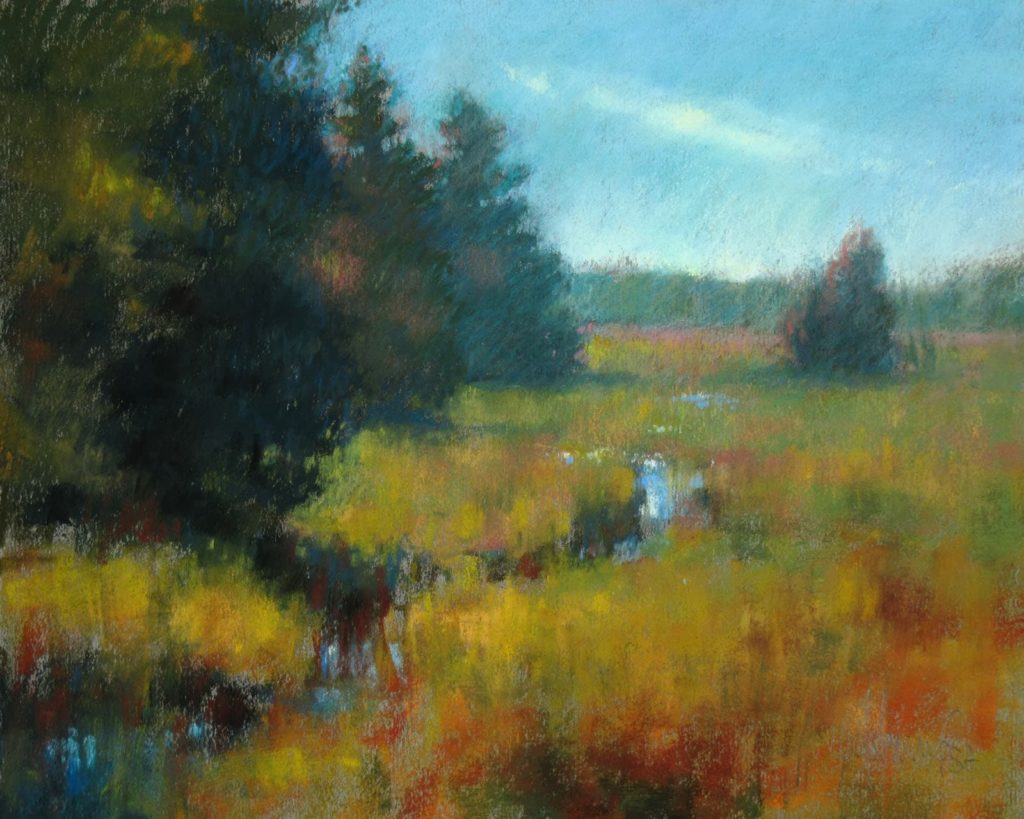
As a landscape painter, I aim to make my pictures look existent. This ways conjuring up an illusion of depth that gives viewers the feeling they could stroll correct into the scene. Without this fleck of magic, the picture looks flat and uninviting.
Two Types of Perspective
When we become for a walk, we have the do good of seeing the world with stereoscopic vision. Our ii eyes allow u.s.a. to meet what's closer and what's farther away, which helps united states to navigate without bumping our shins. On the other hand, the viewer of a painting is, in a sense, visually handicapped. Because the surface of a painting is flat, looking at it is like seeing the scene with only 1 eye. In guild to help the viewer, I similar to "button" the illusion of depth.
This is where perspective comes in; information technology's vital to creating the illusion of depth. At that place are basically ii kinds of perspective: linear and aerial. Linear perspective is the blazon we nearly often recall of. Its lexicon includes vanishing points; one-, two-, and three-indicate perspective and horizon lines. An Italian engineer and architect, Filippo Brunelleschi, laid out this geometric arrangement for cartoon buildings in 1413, during the Renaissance.
The second kind of perspective, aeriform (or atmospheric), has to do with how the air between the states and an object affects our perception of the object's colour, especially with regard to value, temperature, and blush. Unlike linear perspective, which is an bogus organization used to create the illusion of space, aerial perspective is a product of natural laws. It was showtime used in the Netherlands during the 15th century. Leonardo da Vinci, amidst others, observed and catalogued the effects and theorized why the furnishings occurred.
Prior to the Renaissance, many European paintings looked flat and 2-dimensional. As observations grew more acute and mathematics more precise, both aeriform and linear perspective helped artists achieve a high level of realism, epitomized in Flemish nevertheless life and landscape paintings of the 17th century.

Linear Perspective Clues
The techniques of perspective can be boiled down to a few simple tricks. But they're non tricks, really; they're important visual clues, all based on shut observation from life. Every mean solar day we see and visually interpret these clues, but we're then used to them that we don't notice — unless we've developed a smashing center while in the addiction of working directly from life.
As artists, nosotros demand to recognize that these visual clues can exist valuable tools in making a successful painting. Let'south first accept a look at what tools linear perspective offers united states of america.
Overlapping objects


Overlapping objects tell us what'south in front of what (I allocate this with linear perspective because it has to do with the positioning of shapes). It'south a unproblematic concept. We learned as toddlers that if 1 affair obscures another, that means the matter obscured is further away. It'southward surprising how oft this concept is forgotten by starting time painters. You should overlap shapes equally much as possible to brand the spatial relationships clear.
Scale

The calibration, or apparent size of an object, diminishes with distance. We've all seen a row of telephone poles and noticed that the ones farther off seem to be smaller. You don't need telephone poles to make the illusion piece of work in a painting. Only include a few objects that are familiar to the viewer and of similar actual size (as opposed to apparent size) so that the diminution makes sense. Including figures is i way of showing scale.
Aerial Perspective Clues
Now let's look at aerial perspective. Air scatters sky lite, and any dust or moisture suspended in the air increases the scattering. This scattering is responsible for most of the atmospheric effects we encounter, and the more air between the viewer and an object, the more pronounced the effects are.
The next ii clues deal with the style atmosphere affects value.
Contrast
Contrast decreases with altitude. Some of the scattered heaven light spills into dark areas or may even be bounced dorsum to the viewer, making the dark areas seem lighter. Light areas are also affected, but the result isn't every bit apparent.
Sharpness of Edges
The sharpness of edges also decreases with distance. An edge is defined as a value contrast between ii adjacent shapes, and the sharper the contrast, the sharper the border. Considering contrast decreases with distance, the edges, existence dependent on contrast, seem to become softer.
The adjacent 2 aeriform perspective clues deal with color. Scattered sky light is a depression-chroma blue, and that sky light affects the color of objects
information technology falls upon.
Temperature
The temperature of a color decreases with altitude. The scattered blue sky light shifts colors to the libation end of the spectrum. Colors don't necessarily become blue, however. Red, for example, becomes a slow red-violet, then a dull violet. Yellowish becomes a dull yellow-green.
Chroma
The blush (richness) of a color decreases with altitude. The scattered blueish heaven light isn't a high-chroma blue; instead, the blue is mixed with white calorie-free (other colors), thus lowering its chroma. This "impure" light is what decreases the saturation of all colors in the mural. At infinity, one can expect the color to become completely desaturated.
Additional Clues
There are two more than ways to create depth that I detect helpful. Particular (equally well as texture) diminishes with distance. For example, in a grassy field, the foreground grasses may prove individual stalks and leaves. As you expect farther out, the individual stalks merge into larger masses.
In landscapes especially, a road, stream or fence line that runs from the foreground into the altitude provides an easy path for the eye. Although this approach can be heavy-handed, a subtle eye path tin can be an constructive clue to receding distance.
Space in a Nutshell
In curt, to create the illusion of depth and space, make sure you lot proceed your warm and rich colors, night accents, textural marks, and detail in the foreground. Save your cool and deadening colors, softer edges, and depression-contrast elements for the middle basis and altitude. In addition, use overlapping and scaled elements to advise altitude. Finally, if you tin can notice a path for the eye, include information technology. You tin can come across how I implement many of these clues in the demo below.
Even when I don't meet all of these clues in the scene before me, I include or exaggerate their effects so visual depth is conspicuously conveyed. Doing so keeps my viewer from getting "lost in space."
Demo: Give the Viewer Some Infinite!
The following sit-in shows how aeriform perspective, texture, and a path for the eye tin be used to enhance the sense and illusion of depth in a landscape.
Materials:
- Surface: Canson Mi-Teintes pastel paper in steel greyness
- Pastels: Prismacolor NuPastel, Faber-Catell Polychromos, Rembrandt, Mount Vision, Girault, Sennelier
- Fixative: Lascaux spray

1. Block In
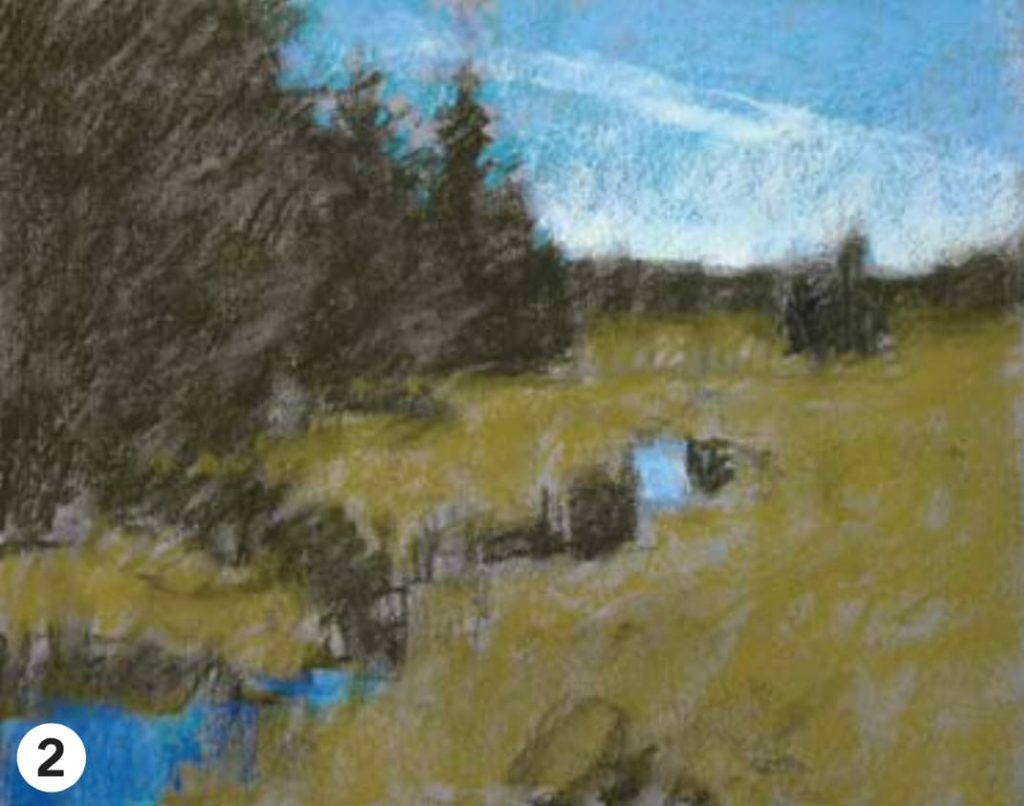
It's very easy to block in a painting with just a few simple colors and then apply aeriform perspective to create the illusion of depth. In this first stage, I've blocked in with a dark, warm green for the copse; a lighter, warm dark-green for the grassy surface area; and a mid-value blue for sky and water. This block-in has a flat appearance, almost like a poster. The only clues to distance come up from linear perspective elements: the path for the eye created by the stream and the diminishing credible size of trees in the distance.
2. Prepare Value Range
My values were generally right, merely the sky and water were too apartment. I lightened the lower sky with a creamy, calorie-free yellow tint. This value dictated how lite I could make the distant line of trees. I similarly lightened the far end of the water, where it reflects the lower sky. I darkened the near water, where it reflects the unseen overhead heaven, with dark royal. This dictated how dark (and saturated) I could make the grasses.

three. Suit Tree Values
I scumbled over the farthest copse with lighter, cooler greens, and also some blues. As I worked my way to the closer trees, I used darker and warmer greens. I also introduced a very nighttime note into the adumbral side of the closest tree so information technology would have more dissimilarity between light and dark. After my initial pass in these areas, I went dorsum in with blues and greens to fine-tune the effect until I was satisfied with the illusion of depth and distance.

4. Adjust Grass Values
The grasses needed a similar treatment. I worked a calorie-free red-violet over the nearly distant grasses to both grayness downwards and absurd the greens. As I moved from background to foreground, I started with cooler bluish-greens and gradually warmed upwards the colors, ending with oranges, reds, and yellow- greens. In the distance I kept my marks small and soft, but in the foreground I fabricated them larger and sharper- edged to make the grasses seem close to the viewer.
5. Final Touches
I connected fine-tuning the temperatures, chromas, values, textures, and edges, resulting in a convincing illusion of distance in Barrier Beach Grasses.
Michael Chesley Johnson is a frequent contributor to Artist's Magazine. Johnson teaches plein air workshops throughout the Us. Visit his website at mchesleyjohnson.com.
Source: https://www.artistsnetwork.com/art-techniques/perspective/how-to-create-the-illusion-of-depth-a-demo/
0 Response to "what technique is used to create the illusion of weight"
Post a Comment